
What is Down syndrome?
Down syndrome (DS) is a genetic abnormality in which there is an extra 21st chromosome or extra material on the 21st chromosome. It is characterized by certain physical traits such as up-slanted eyes and a palmar crease in the palm of the hand as well as mental traits such as impaired cognitive function. There is a spectrum of the severity of DS that can be influenced by factors including access to therapy and early intervention services.
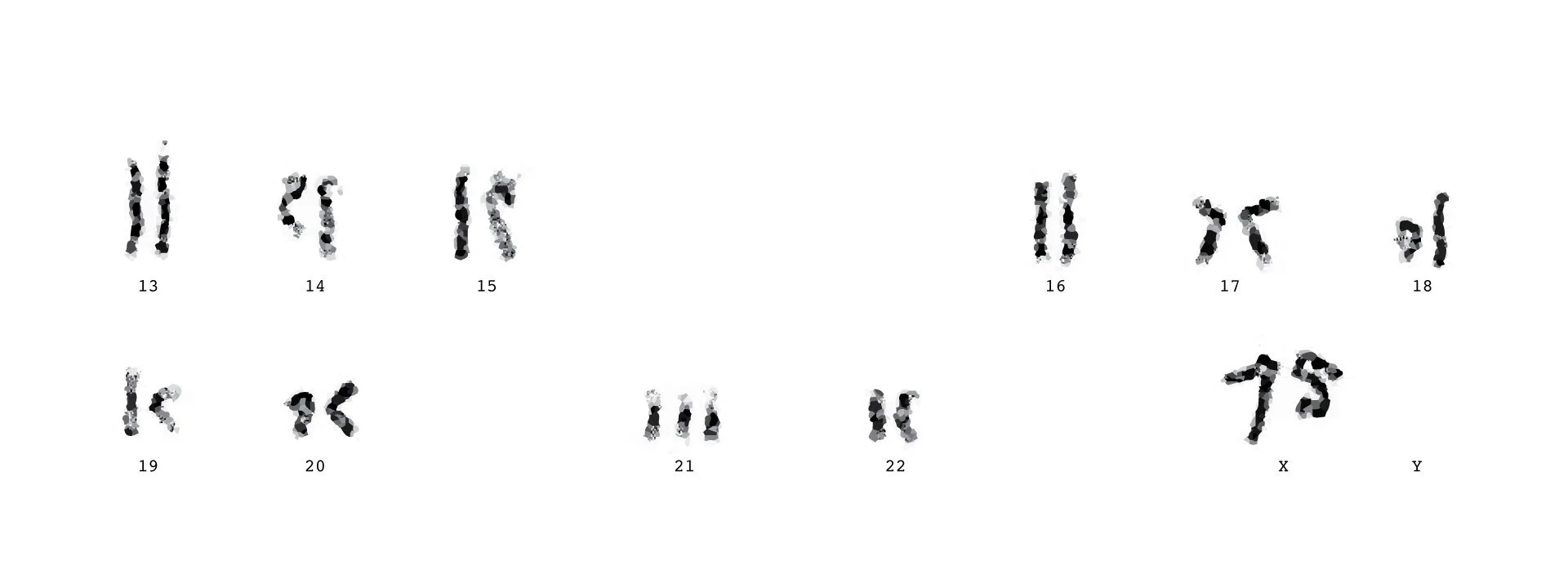
DS is the most common chromosomal abnormality in humans and occurs in about 1 in 700 live births.
These are Lily’s chromosomesIn the case of DS caused by non-disjunction, rather than each parent giving one chromosome for the chromosome numbered 21, one parent gives 2. The result is a trisomy on the 21st chromosome, ie the baby has an extra chromosome and has DS. Less commonly, there is a mosaic type of DS in which the same process of non-disjunction occurs, however, it does not happen in every cell. As a result, some cells have 3 copies of chromosome 21, while other cells have the normal amount of 2 copies. Additionally, there is DS caused by a translocation.
A translocation occurs when a piece of another (not #21) breaks off and joins with the 21st chromosome. Generally, it is chromosome 14 that donates the extra piece to the 21st chromosome. With the extra material on #21, the diagnosis of DS is made and it is confirmed by karyotype, as seen in Lily’s above.